X · In his words
What they said Patrons, reporters, rivals and friends, over half a century
Enzo Ferrari, Denis Jenkinson, Hunt, Prost, Watson, Stewart, Hamilton and Wolff on Niki Lauda, from Motor Sport in 1972 to the farewells of May 2019 and after.
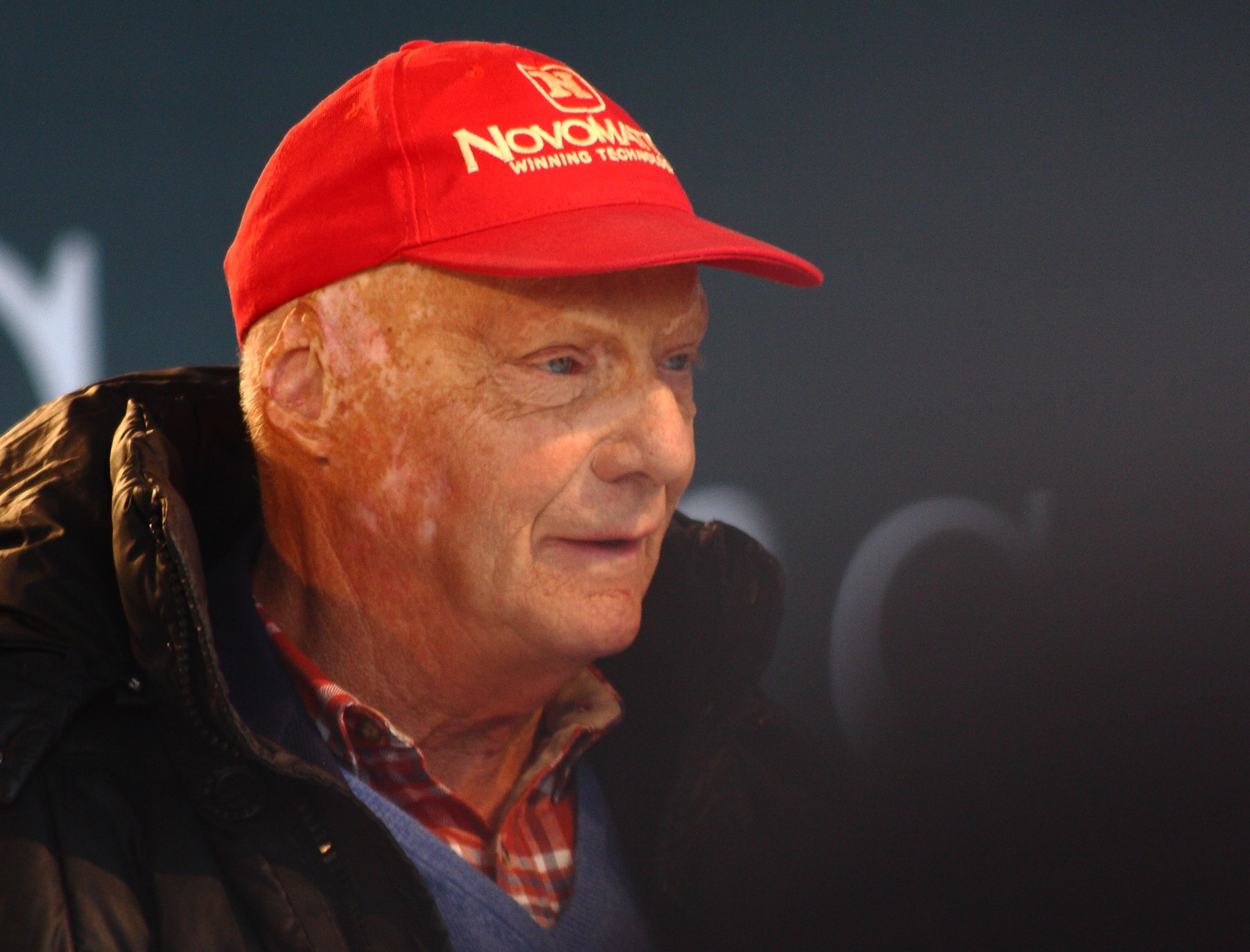
X · In his words
In February 1972 Motor Sport previewed the Formula One season and gave the newcomer at March a line, with his first name misspelt: “Rather breathlessly in pursuit will be the young Austrian Nicki Lauda.” In 2019 the President of Austria spoke at his Requiem in St Stephen’s Cathedral.
Between those two dates a great many people said what they thought of Niki Lauda. This page gathers what can be shown to have been said, by the men who hired him, the reporters who watched him, the drivers he raced and the people who worked with him at the end. Words first printed in another language are marked as translations or shown in their original. The lines that circulate without a reliable source, among them one given to Enzo Ferrari and a paraphrase of James Hunt, are gathered on In his words. His own words are in In his words too.
The men who hired him
The men who hired him
He paid for his first seasons in Formula One. Robin Herd, the designer of the March cars he drove in 1972, remembered in 2009 that the team had not listened to him about the 721X:
Ronnie and I had built ourselves up into this untouchable team, and we were blind to the 721X’s problems. Niki wasn’t. He sussed it straight away. He came in after two or three laps, said it was bloody rubbish and went off in a huff. And he was right.
Niki was very, very bright, very strong-minded, but, unlike Ronnie, who looked like a racing driver, Niki looked like a little rat, with that buck-toothed smile. He was a ‘rent-a-driver’. He was good, I knew that, but I just couldn’t bring myself to listen to him.
At BRM in 1973 the team manager was Tim Parnell. Alan Henry quoted him in Motor Sport in 2005:
You could see straight off that he had that little bit extra; up to that point I had never seen such dedication. Niki also came into F1 at a time when physical fitness had become an issue; he worked away at it and became what I can only describe as 150 per cent fit. He was terribly serious about his racing. It never surprised me that he made it to the top.
How Enzo Ferrari came to want him is told two ways. Lauda remembered being told at Maranello that Ferrari had seen him at Monaco, driving ahead of a Ferrari; another account, an English version of Ferrari’s own words quoted by Henry in 2005, has Ferrari consider him from the British Grand Prix that July, with Clay Regazzoni encouraging the choice:
It was he [Regazzoni] who encouraged me in my choice of the racer I had been considering since the British Grand Prix to fill a gap in the team for 1974. Lauda is young and unknown, but he seems to be bright. I think he could do a lot with Ferrari.
In his later writing Ferrari gave his considered judgement, here in an English version:
He worked like a professional … meticulous in his preparation of both himself and his car, something for which he showed a natural, instinctive gift.
The press box
The press box
Denis Jenkinson of Motor Sport watched him from his BRM year to his last season, and changed his mind about him more than once. At the Nürburgring in 1973 he praised the courage and doubted the technique:
The performance by Lauda was particularly courageous, making the other BRM performers look a bit hopeless, but it was achieved more by enthusiasm than skill, for the young Austrian continues to arrive at corners too fast and leave them too slowly, instead of the reverse, which produces smoother, cleaner and faster driving.
A year later, after the Dutch Grand Prix at Zandvoort, which Lauda won from pole position in the Ferrari, he did the arithmetic:
If you think of a second as ten parts, and realise that only one or two parts usually separate the top runners, it is staggering to think that Lauda was twelve parts faster than the best of the Cosworth runners.
By the middle of 1975 he saw a different driver:
The fast but rather uncertain Niki Lauda of 1974 has matured and no longer looks about to make a mistake and uses the Ferrari to the full.
Yet when the title was won that September, Jenkinson would not call him great:
While Lauda is a worthy World Champion, having been the pace-setter and frequent winner all season, he is hardly likely to go down in history as a truly great Champion, for his domination has not been anything like complete.
His colleague Alan Henry saw the season end at Watkins Glen with a win, and judged it otherwise:
By rounding off his season in such spectacular style, Niki Lauda has managed to add a tag of distinction to his World Championship title, a title too often diminished and diluted by drivers who prefer to drive with Championship points in the forefront of their mind rather than the prospect of winning motor races.
Jenkinson’s hardest words were about Fuji, where in 1976 Lauda stopped in the rain and lost the title by 1 point. In 1977, with Lauda champion again, he wrote:
To me he is a man with no pride.
John Watson, who was there, told Simon Arron in 1996 how he understood the stop: “Frankly, I think the guy was shitting himself, and quite understandably too.”
After the comeback of 1982 the tone changed. Jenkinson wrote of the Belgian Grand Prix at Zolder:
Lauda’s smoothness and finesse really does make a lot of drivers look like rank amateurs. … Very shrewd is Niki Lauda, a true professional racing driver.
Henry, from Kyalami in 1984:
Lauda’s performance was a copy book demonstration of precisely why the Austrian has won so many races in his decade-long Grand Prix career: he was smooth, and predictable to the point of boredom, whilst at the same time tremendously quick.
And in October 1985, after Lauda’s last win, at Zandvoort, Jenkinson used his nickname:
This was vintage Lauda, for he is not called ‘the wily Rat’ for nothing. … It’s called ‘track-craft’ and nobody has more of it than Lauda.
1976
The fire, and after
The Guardian’s report the next day on the crash of 1 August 1976 at the Nürburgring Nordschleife was clear that several drivers had saved him. Eric Dymock wrote:
The 27-year-old Austrian almost certainly owes his life to other drivers, including Guy Edwards, aged 32, from London, who stopped to pull him out of his blazing car.
Guy Edwards, one of them, said later: “It was just a natural response. I was there, and there was no-one else there initially except a few marshals…” Brett Lunger, another, said in 2022 that Arturo Merzario had made the difference by undoing the seat belt. The Nürburgring sets out who did what, as far as the sources allow.
At Monza, 42 days after the crash, he raced again. Jackie Stewart remembered it in 2019:
Niki had a degree of bravery that I had never seen the like of before … I remember seeing Niki put his helmet on, and his wounds were still absolutely obvious. To be brave enough to put on the helmet was amazing, but then he went out and qualified fifth.
He will not go down as just one of the best drivers of all time, but one of the most courageous, too. Niki Lauda will be remembered forever.
Not everyone was generous. In 1977 Huschke von Hanstein, of the company that ran the Nürburgring, answered Lauda’s refusal to race there again:
Lauda ist feige, wenn er da nicht mehr fahren will … Ich bin selber dort gefahren, ohne zu klagen.
Lauda is a coward if he won’t race there any more … I raced there myself without complaining.
His rival for the title was his friend James Hunt. At Fuji, as the 2016 printing gives his words, Hunt said:
I feel really sorry for Niki. I feel sorry for everybody that the race had to be run in such ridiculous circumstances because the conditions were dangerous and I fully appreciate Niki’s decision. After an accident like he had, what else could he do? Quite honestly, I wanted to win the championship and I felt I deserved it. But I also felt Niki deserved to win the championship – and I just wish we could have shared it.
Team-mates
Team-mates
John Watson was his team-mate at Brabham in 1978, then at McLaren in 1982 and 1983; he knew him from 1971, when Lauda arrived in a bank’s cap. Watson spoke of him often, and not always kindly:
I liked Niki personally but he didn’t give a damn about me professionally. In effect he became number one and didn’t want me to be a problem in his quest to win a third championship, with Brabham. … He was a very impressive competitor in whatever area you choose to look at.
he was the most indiscreet man I’ve known – you could never tell him a secret.
Alain Prost joined him at McLaren for 1984, was faster in qualifying, and lost the title to him by half a point. Thirty years later he explained it to Adam Cooper:
We were not fighting on the same register. That means I was always quicker than him in qualifying. In the races he was not quicker, but he was always there, you know! You could not believe that he was able to come back. … I was like a rabbit for Niki. I never considered in the first part of the season that he could be able to beat me in the championship, and that was a mistake!
In ’84 I learned a lot, because I said to myself that maybe the quickest driver is not going to win the championship… in the end Niki’s way was right.
The engineers saw the same thing from the pit wall. John Barnard, who designed the car, remembered a rare moment of all-out attack:
I remember him saying to me, ‘This f***ing little Frenchman is always half a second quicker than me, I’ve got to figure out what to do’. … It was the one time I saw Niki just chuck everything at it and go for it big time.
His colleague Steve Nichols put it in one sentence:
The thing that stood out about Lauda more than anything else was his absolutely iron-willed determination to get the job done. No matter what it took, no matter how hard it was.
Mercedes, 2012–2019
The last chapter
In 2012 he telephoned Lewis Hamilton, then at McLaren, to bring him to Mercedes; on 28 September the team announced Hamilton and named Lauda its non-executive chairman. Hamilton remembered their meeting in Singapore:
We started talking some time in 2012 and I just remember being home during the day, having a call from Niki and he is trying to convince me to come to the team… Then we sat together in Singapore, he came to my room and we had a good conversation. I think that was the time when Niki was like: ‘Oh my god, you are just like me in so many ways’.
Daniel Brühl, who played him in the film Rush, had described his directness in 2013:
He’s very sharp and honest … He never repeats himself like I do. I’m a very redundant talker. Never would there be a word too much with him because that’s a loss of time, a loss of money. … He has a reputation for being cold and strict, but I had a perfect time with him, he supported me with everything I needed.
He died in Zürich on 20 May 2019. The next day Hamilton wrote on Instagram:
I wouldn’t have even been in this team if it wasn’t for you.
The Mercedes statement came from Toto Wolff, the team principal:
he combined heroism, humanity and honesty inside and outside the cockpit.
At Monaco two days later Wolff spoke to the press:
I feel we have lost what was the heart and soul of F1.
On 26 May Hamilton won the Monaco Grand Prix and said afterwards: “When I was driving I thought: ‘What would Niki do?’”
Afterwards
The writers’ verdicts
The obituaries tried to sum him up. Richard Williams wrote in The Guardian:
He was a man without a scintilla of narcissism. … his unfailing readiness to offer journalists a brusque but highly quotable opinion – usually something along the lines of ‘the car is shit’ – was not lost to Formula One in his subsequent years as a TV pundit or in managerial roles, during which he never forsook the red baseball cap adopted in 1976 to cover his seared scalp.
Damon Hill told Sky Sports:
Everyone who was in Formula One knew Niki’s personality as one of the most potent individuals in the sport … He was highly intellectual, stoic, someone who didn’t have time for any of the BS in the business at all. He was eminently quotable all the time. It’s very sad to hear that we’ve lost Niki, but so many people have been affected positively by having known him.
Ten years earlier the writer Clive James had put the same quality in other terms:
A racing car is just the most concentrated possible form of a system tending towards entropy. Schumacher understands the second law of thermodynamics. So did Lauda.
Prost spoke to Agence France-Presse in French; in an English version of his words he said: “we lose a gentleman who has never complained about anything in his life, his condition, his accident, and who has always won” (attributed). Five years earlier he had said something simpler about the half point of 1984:
When he won the championship I was not sad at all… At the end I felt happy for him. … Coming back after stopping his career and being world champion, and beating me by half a point, it was so good for the history of F1 and I am really proud to be part of that story.
The family’s own words came first, by e-mail in the night after he died. How Austria said goodbye, on 29 May in St Stephen’s Cathedral, is told in The Austrian.
In tiefer Trauer geben wir bekannt, dass unser geliebter Niki am Montag, den 20.05.2019, im Kreise seiner Familie friedlich entschlafen ist. Seine einzigartigen Erfolge als Sportler und Unternehmer sind und bleiben unvergesslich. Sein unermüdlicher Tatendrang, seine Geradlinigkeit und sein Mut bleiben Vorbild und Maßstab für uns alle. Abseits der Öffentlichkeit war er ein liebevoller und fürsorgender Ehemann, Vater und Großvater. Er wird uns sehr fehlen.
In deep sorrow we announce that our beloved Niki passed away peacefully on Monday, 20 May 2019, surrounded by his family. His unique achievements as a sportsman and entrepreneur are and will remain unforgettable. His tireless drive, his straightforwardness and his courage remain an example and a yardstick for us all. Away from the public eye he was a loving and caring husband, father and grandfather. We will miss him very much.
Sources
“Grand Prix scene”, Motor Sport, February 1972. motorsportmagazine.com
“G hits the spot” (Robin Herd), Motor Sport, March 2009. motorsportmagazine.com
Alan Henry, “Niki Lauda: Ferrari’s F1 ‘quick-fixer’”, Motor Sport, March 2005; and “Niki Lauda: The years of the Rat”, March 2009. motorsportmagazine.com
Denis Jenkinson, “German Grand Prix”, Motor Sport, September 1973; “Reflections in the sand”, August 1974; “Grote Prijs van België”, July 1975; “Reflections in the Royal Park”, October 1975; “European letter”, November 1977; “Grote Prijs van Belgie”, June 1982; “Dutch Grand Prix”, October 1985. motorsportmagazine.com
Alan Henry, “The United States GP”, Motor Sport, November 1975; and “South African Grand Prix”, May 1984. motorsportmagazine.com
Simon Arron, “The Waterboys”, Motor Sport, November 1996. motorsportmagazine.com
Eric Dymock, “Niki Lauda badly injured in German Grand Prix”, The Guardian, 2 August 1976. theguardian.com
Richard Jenkins, “Guy Edwards QGM interview”, OldRacingCars.com. oldracingcars.com
“Meet the American driver who saved Niki Lauda from his fiery 1976 Nurburgring crash”, PlanetF1, quoting Brett Lunger to Autoweek (2022). planetf1.com
“In meiner Klasse muß ich alle niederbügeln”, Der Spiegel 40/1977, 25 September 1977. spiegel.de
Paul Weaver, “Niki Lauda: ‘James Hunt would not push you off the road’”, The Guardian, 5 October 2016. theguardian.com
Adam Cooper, “I never considered early on that Niki could beat me to the championship”, Motor Sport, October 2014. motorsportmagazine.com
“John Watson: The Motor Sport Interview”, Motor Sport, September 2022. motorsportmagazine.com
John Watson, “My friend Niki Lauda was a street-fighter and a shining talent in F1”, The Guardian, 21 May 2019. theguardian.com
Giles Richards, “Niki Lauda, three-times Formula One world champion, dies aged 70”, 21 May 2019; “There is a huge black cloud”, 23 May 2019; and “Niki Lauda was ‘racing with me’ during Monaco win, says Lewis Hamilton”, 26 May 2019, The Guardian. theguardian.com
Luke Smith, “Hamilton recalls first meetings with Lauda before Mercedes move”, Motorsport.com, 20 May 2020. motorsport.com
Alex Godfrey, “Daniel Brühl: Rush, Niki Lauda and me”, The Guardian, 5 September 2013. theguardian.com
Richard Williams, “More than a machine: Niki Lauda was an F1 rebel in his own way”, The Guardian, 21 May 2019. theguardian.com
Richard Williams, “Niki Lauda obituary”, The Guardian, 21 May 2019. theguardian.com
Clive James, “On Niki Lauda”, in The Revolt of the Pendulum (2009). clivejames.com
“Prost: My most splendid and brilliant years were as teammate to Niki”, GrandPrix247 (AFP), May 2019. grandprix247.com
ORF, “Formel-1-Legende Niki Lauda ist tot”, 21 May 2019. orf.at