Part One · The life
V
Monza and Fuji 1976: the return and the rain
Niki Lauda raced again at Monza 42 days after the fire and finished 4th, then stopped at Fuji in torrential rain and lost the 1976 title to Hunt by a point.
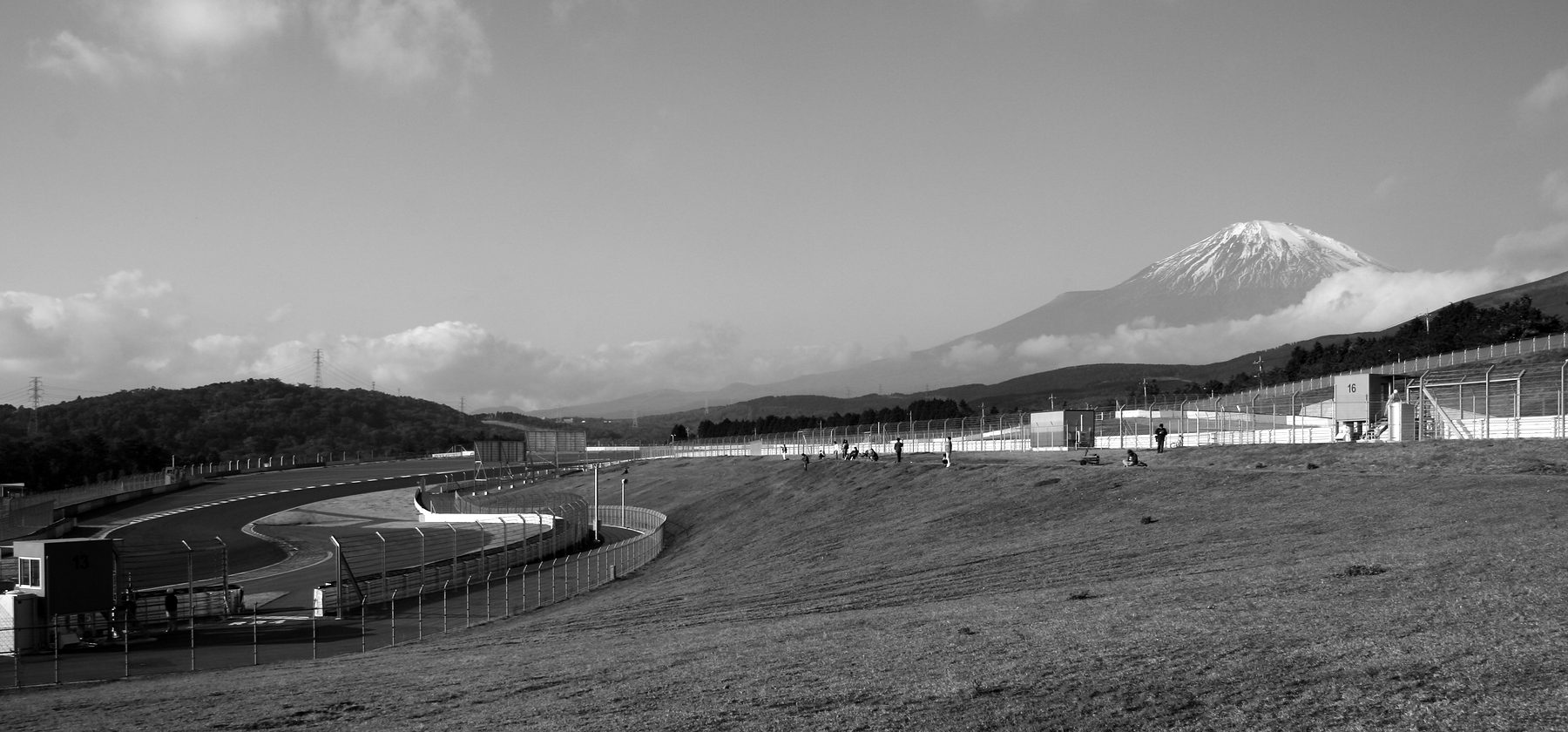
Then came that soaking Japanese Grand Prix at Mount Fuji when I pulled out on the second lap, convinced that driving in those conditions of torrential rain was absolute lunacy.
V · Monza and Fuji
The championship did not wait for him. While Niki Lauda lay in hospital after the fire at the Nürburgring on 1 August, James Hunt won the restarted race in Germany and then the Dutch Grand Prix, and Ferrari, which had withdrawn in anger, missed one race and came back to the next with a single car. Lauda missed two races, Austria and the Netherlands, whatever he later remembered. By the beginning of September, by Der Spiegel’s reckoning and Lauda’s own, Hunt had closed to within 2 points of him.
That, the magazine wrote a month later, was why he risked a start at Monza. On 8 September ORF, Austrian television, broadcast his first interview since the crash, an item its archive lists under the title Ich fahre weiter, “I am racing on”. Hans Halter of Der Spiegel later gave the resolve he had made after the crash in his own words: “Now you do everything the doctors say, three hundred per cent.”
His wounds had not healed. He had a special helmet made, larger than his old one, to fit over the dressings on his head. From his return at Monza he wore a cap over his scars, and so began the red cap whose story is told in The Austrian.
Ferrari brought three cars to the Italian Grand Prix. Lauda drove chassis 026, the Ferrari 312T2 he had raced in the first half of the season; Clay Regazzoni drove the second, and Carlos Reutemann the third. Practice began on Friday 10 September, 40 days after the crash. The race, on Sunday 12 September, was the 42nd day.
Monza
Monza, 12 September 1976
Friday was lost to torrential rain; Denis Jenkinson of Motor Sport called the day an absolute dead loss. When Lauda appeared, everyone cheered and clapped. His burns were still visible, but Jenkinson found him looking fit, and wrote that he did not indulge in heroics in the wet and was greeted with enthusiasm all round the circuit. Hunt, by contrast, was met with whistles and catcalls, from a crowd Jenkinson put at some 80,000.
On the Friday I could not drive. I got out of the car because I was frightened … I went to the hotel and thought about it, took it easy on Saturday and then finally got going again.
His own account of that Friday, given 40 years later in Maurice Hamilton’s book on Hunt, is starker. The two do not conflict: the report of 1976 has him on the track on Friday, but not pressing, and by his own telling he found his way again on Saturday.
The grid was decided in a single hour on Saturday morning. Jacques Laffite took pole position in his Ligier in 1:41.35; Lauda was 5th in 1:42.09, the fastest of the three Ferraris, on the third row beside Hans-Joachim Stuck. Jenkinson saw him quietly showing that he had lost none of his touch.
The fuel
At midday on Sunday the organisers announced that fuel taken on Saturday from the McLaren and Penske cars had been above the permitted octane level. Their Saturday times were struck out and their wet Friday times used instead. Hunt went to the back of the grid, and his team-mate Jochen Mass started last, after Williams withdrew Arturo Merzario’s car; Guy Edwards gave up his place so that John Watson could start.
The figures were disputed then and still are. Ferrari’s fuel was given as 98.6; McLaren’s as 101.6 by Der Spiegel and 101.7 by Hunt, and whether either broke the rule is disputed: the limit was 101, and Hunt and Der Spiegel disagreed about the tolerance allowed above it. Der Spiegel reported that Lauda had urged his team manager to press the protest. Jenkinson thought the ruling a masterstroke by the Italians against anyone who might challenge Lauda and the Ferraris; Hunt said simply, years later, that the Monza authorities had cheated. Jenkinson noticed a small sign of it: the spare March still carried a Penske sponsor’s stickers under masking tape, and Max Mosley peeled the tape away once Penske’s times had been struck out.
The race
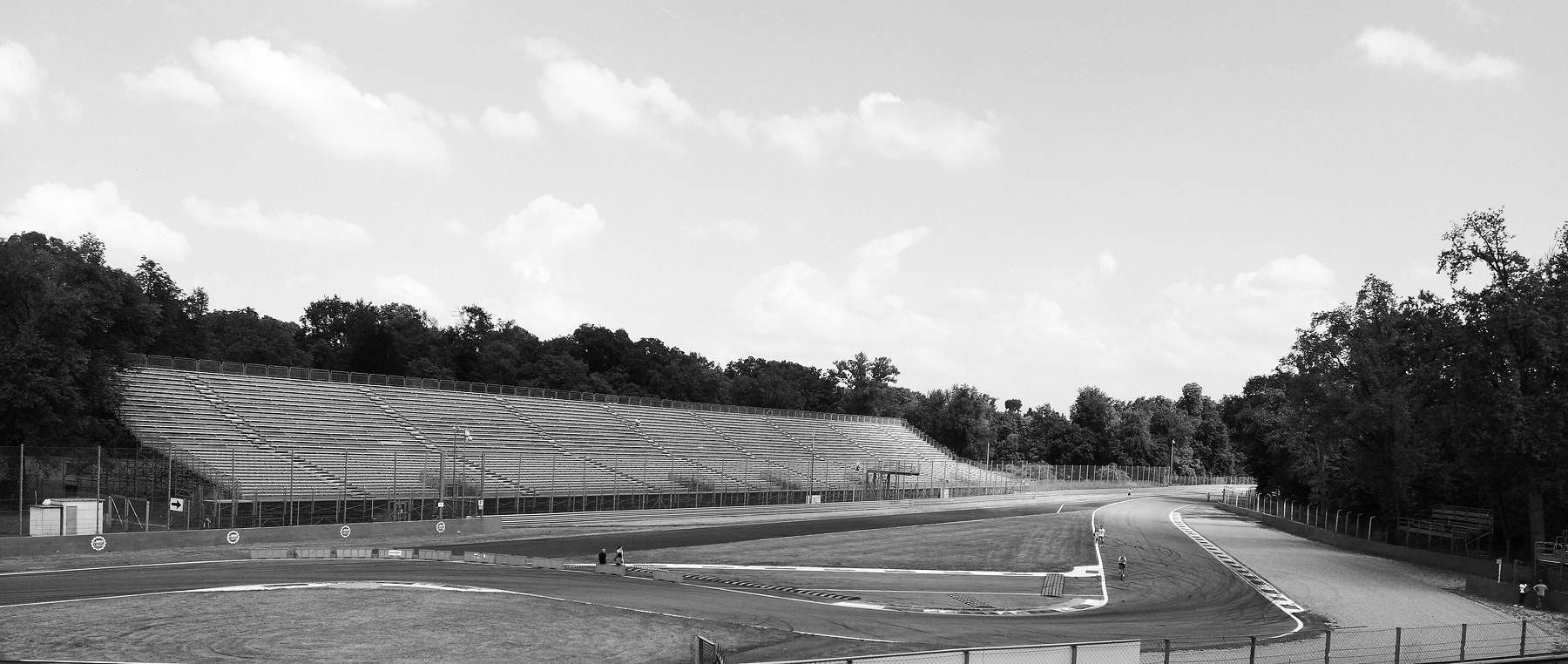
The start was given by new red and green lights, with no 10-second board, and they caught out several drivers, Lauda among them. He was 9th after 6 laps. On lap 13, Jenkinson wrote, he passed the grandstands to wild cheering, alongside Brambilla and about to take 6th place. Hunt, coming up from the back, spun off after a wheel-to-wheel fight with Tom Pryce’s Shadow.
Around lap 23 the clerk of the course showed a black flag with a white cross, the signal that the race would be stopped next time round because of a light rain. The leaders ignored it, and the race went on in confusion. Lauda passed Jody Scheckter on lap 41, and in the closing laps he caught and passed Patrick Depailler, whose engine was misfiring. On the last lap he slipped coming out of the Vialone chicane and Scheckter closed on him, but he held on through the Parabolica and crossed the line a tenth of a second ahead.
Niki had a degree of bravery that I had never seen the like of before … I remember seeing Niki put his helmet on, and his wounds were still absolutely obvious. To be brave enough to put on the helmet was amazing, but then he went out and qualified fifth.
He will not go down as just one of the best drivers of all time, but one of the most courageous, too. Niki Lauda will be remembered forever.
Ronnie Peterson won for March, with Regazzoni 2nd and Laffite 3rd. Lauda was 4th, 19.4 seconds behind the winner, and scored 3 points. According to Jenkinson he twice set the fastest lap towards the end, before Peterson lowered the record on lap 50.
The crowd began a rhythmic chant for Lauda, and nobody, Jenkinson wrote, denied that he was the real hero of the day. He was too exhausted to reach the winner’s rostrum.
October
Three points
Late in September the FIA’s Court of Appeal disqualified Hunt from the British Grand Prix, which he had won in July, and gave the win to Lauda. In North America Hunt answered by winning both races: in Canada, at Mosport on 3 October, where Lauda was 8th after his car’s handling went off late in the race, and in the United States, at Watkins Glen on 10 October, where Lauda was 3rd. One race was left, the first World Championship Grand Prix to be held in Japan, and Lauda led Hunt by 68 points to 65.

The arithmetic was simple. If Lauda scored nothing, a win, 2nd or 3rd place would make Hunt champion. A 4th place would give Hunt 3 points and tie them on 68, and Hunt would then take the title on wins, six to five.
- Lauda’s points before Fuji, to Hunt’s 65
- 68
- Hunt’s points after Fuji, to Lauda’s 68
- 69
Fuji
Fuji, 24 October 1976
The race was run on the short circuit at Fuji, 4.359 kilometres (2.7 miles) a lap, over 73 laps; the banked section had not been used since a fatal accident in 1974. Practice on Friday and Saturday took place in fine autumn weather. Mario Andretti took pole in 1:12.77, Hunt was beside him in 1:12.80, and Lauda 3rd in 1:13.08. The last hour, wrote Alan Henry in Motor Sport, became the duel between Lauda and Hunt that had been so frequent before the Nürburgring. The Japanese drivers had their moments: on Friday Masahiro Hasemi’s Kojima, on Dunlop qualifying tyres, was briefly fastest.
Before practice Ferrari’s team manager, Daniele Audetto, protested that Hunt had driven laps in the wet the Saturday before, after the teams had agreed not to test. Lauda, Henry noticed, kept his eyes elsewhere and waited for Audetto to finish. Two weeks before the race Der Spiegel had written that McLaren were counting on his difficulty with the change of time zones: he suffered headaches at races overseas, the magazine said, and his left eye, damaged in the fire, watered.
On Sunday it rained. Henry described streaming rain and a low cloud that hid Mount Fuji completely, and a mist that cleared one minute and returned the next, cutting visibility to a hundred yards or so. The morning warm-up became an argument between those who were quick in the wet and wanted to race, Tom Pryce, Peterson and Stuck among them, and those who were more prudent, among them Hunt, Lauda and Emerson Fittipaldi. A drivers’ meeting voted by a substantial majority that the circuit was too dangerous. By then the organisers had decided to go ahead. McLaren’s Teddy Mayer remembered in 1996 that the officials had decided there would be a race, whether the drivers liked it or not.
As it was starting to get darker, the organisers said, ‘Right, we have to race now because of TV.’ I thought it was idiotic – why hadn’t we started earlier when the light was better, because the rain was no different? This stupidity, because of TV, meant conditions were wholly unacceptable. And anyway, I didn’t lose the championship because of Fuji – I lost it because I missed three races after my accident…
The start was late, with the light already failing. Most accounts put the delay at about an hour and a half; Mayer remembered about two hours. Lauda said in 2016 that the clerk of the course came into the room and told the drivers they had to start within half an hour, because of the worldwide television rights and because Bernie Ecclestone was putting pressure on him; as the drivers’ spokesman, Lauda said, he stood up and told them they were mad. Henry’s report of 1976 says only that the organisers had decided. Ecclestone was there as the constructors’ negotiator; that he forced the start is not established. The television was real enough: Murray Walker remembered that this race persuaded the BBC to show Formula One, with the studio opening at four in the morning.
Two laps
Hunt led from the start. At the end of the first lap Lauda was 10th; Simon Arron later wrote that he lost touch with the leaders after a big moment in one of the puddles. At the end of lap 2 he brought the Ferrari slowly into the pits. The mechanics bent down into the cockpit to see what was wrong. He shook his head, undid his harness and lifted himself out of the car. The World Champion, Henry wrote, considered the conditions far too hazardous.
He watched Hunt go past the pits for a few more laps, then walked slowly to his waiting car and left the circuit. Three other drivers withdrew. Larry Perkins stopped after a lap; Carlos Pace and Fittipaldi went out later, officially with mechanical trouble but, Henry wrote, with the same misgivings as Lauda. In the spray Kazuyoshi Hoshino, in an old Tyrrell on Bridgestone tyres, ran as high as 3rd.
Ferrari offered to tell the world that his car had failed. He would not have it. Who made the offer is told differently: Daniele Audetto, Mauro Forghieri, or both together. Whether he had made up his mind before the start is also disputed. In 2016 Lauda said that he had told Ferrari beforehand that he would do one lap and stop; the report of 1976 and the Italian accounts have the decision taken in the race and announced at the pit. He completed 2 laps, although his own later versions speak of lap 2 in 1998 and of one lap in 2006 and 2016.
The title
Third, by a point
Brambilla caught Hunt on lap 21, and spun. As the track began to dry, Hunt’s rain tyres wore out. On lap 68 a front-left tyre deflated, and his stop dropped him to 5th, with 5 laps left. He passed Regazzoni and the slowing Jones to finish 3rd. Andretti won, with Depailler 2nd. Hunt was World Champion, 69 points to 68. Afterwards Mayer and Hunt disagreed about who should have called the stop.
Lauda learned the result at the airport. In 2016 he told the story of a taxi driver who was asked to listen to the radio for him, and whose radio cut out in the airport tunnel just as the race ended; then, on the ramp, a man from Ferrari was waiting to say goodbye. “And I looked at his face and I knew straight away.” Hunt was champion.
I feel really sorry for Niki. I feel sorry for everybody that the race had to be run in such ridiculous circumstances because the conditions were dangerous and I fully appreciate Niki’s decision. After an accident like he had, what else could he do? Quite honestly, I wanted to win the championship and I felt I deserved it. But I also felt Niki deserved to win the championship – and I just wish we could have shared it.
Hunt’s words after the race were generous, and Lauda never forgot them. 40 years later he called them the nicest comment he had ever heard. Their friendship went back to their junior racing years, 1971 or 1972 by his own accounts, and the rivalry of 1976 did not end it; the chapter on Lauda and Hunt tells it whole.
There were other verdicts. In Maranello, Nigel Roebuck later wrote, Enzo Ferrari was angered by the withdrawal and suggested that Lauda had come back too soon: had he stayed out for the rest of the season, Ferrari might have lost the title but been the moral winners. That winter it was suggested to him that he become the team manager, and he declined with contempt. Lauda remembered in 1998 that many wrote that he was finished, and should be thrown out of the team.
The verdicts
Difficult, or dangerous
Motor Sport’s two reporters took opposite sides. Jenkinson was unsympathetic. In his column of December 1976 he wrote: “So if we are going to withdraw from a race… let’s make it quite clear that it was because it was too DIFFICULT for them, not too DANGEROUS.” A year later he went further, writing that Lauda had handed the championship to Hunt on a plate. Alan Henry took the other view: it was hard to understand Lauda’s decision, he wrote, and impossible to criticise a man who had suffered so much.
The men who had been there were blunter. Watson said 20 years later that he thought Lauda had been frightened, and understandably so: he had just come through hell and did not want to go back. At McLaren, Mayer admitted, they had been glad when Lauda pitted, and thought it served him right; motor racing, he said, can be like that.
Lauda’s own reasons shifted with the years. In 1998 he called driving in that rain lunacy. In 2013 he told Nigel Roebuck: “I stopped because of the conditions – nothing to do with after-effects from the accident.” In 2016 he allowed that without his accident he might have had the reserves to go on. The lines pull in different directions, and each is his.
On one point he never wavered. In 1998 he dismissed the suggestion that he had gambled on Hunt not finishing, and said he would do the same again; in 2016 he said it once more. The film Rush (2013) restaged both Monza and Fuji with dialogue of its own; nothing in this chapter is taken from it.
He stayed with Ferrari, and in the 1977 season he was World Champion again.
V · Monza and Fuji
In his words
I was lucky to have survived that far and I had the choice not to risk my life again.
Sources
Sources
Denis Jenkinson, “1976 Italian Grand Prix race report”, “Notes on the cars at Monza” and “The Formula One scene”, Motor Sport, October 1976; “The Formula One scene”, December 1976; “European letter”, November 1977. motorsportmagazine.com
Alan Henry, “1976 Japanese Grand Prix race report: Hunt brings it home”, Motor Sport, December 1976. motorsportmagazine.com
Simon Arron, “The Waterboys”, Motor Sport, November 1996; Niki Lauda with Alan Henry, “One hell of a guy”, Motor Sport, January 1998. motorsportmagazine.com
Nigel Roebuck, “Niki Lauda: ‘The only one who should beat me was James Hunt because I liked the guy’”, Motor Sport, September 2013, and “9th: Niki Lauda’s sacrifice and James Hunt’s triumph”, Motor Sport, “100 Greatest GPs”. motorsportmagazine.com
Simon Arron, “Breakfast with… Niki Lauda”, Motor Sport, November 2017. motorsportmagazine.com
“Sieger nach Protesten”, Der Spiegel 42/1976; Hans Halter, “Kein Gott, aber gottähnlich”, Der Spiegel 40/1977. spiegel.de
Maurice Hamilton, “Niki Lauda: ‘People had lost their loved ones yet no one was telling them why’”, Observer Sport Monthly, 29 October 2006; Paul Weaver, “Niki Lauda: ‘James Hunt would not push you off the road. We trusted each other’”, The Guardian, 5 October 2016; Giles Richards, “Niki Lauda, three-times Formula One world champion, dies aged 70”, The Guardian, 21 May 2019. theguardian.com
“Japanese GP 1976”. grandprix.com
ORF, “Lauda nach dem Unfall”, Sport, 8 September 1976 (archive page). on.orf.at
F1DB, 1976 Italian and Japanese Grands Prix. github.com/f1db/f1db · Jolpica F1 API, 1976 results. api.jolpi.ca